
Researching the Intersection of Technology, Empathy, and Health for a Better World
At MGX Research Center, our work in HealthTech & Human-Centered Design is rooted in a single conviction: that the future of healthcare must be intelligent, inclusive, and deeply humane. We investigate how digital technologies can be leveraged to improve health outcomes—not just through innovation, but through design that respects the real needs, contexts, and experiences of people.
Our research explores the integration of emerging technologies—AI, mobile health, telemedicine, biosensors, and data analytics—into healthcare delivery, while prioritizing empathy, usability, and equity. We focus on creating scalable, user-centric solutions that support both providers and patients, particularly in resource-constrained environments.
We aim to shape health systems that are not only more efficient, but more accessible, compassionate, and resilient—across Africa and globally.
Research Objectives
• To design and evaluate technology-driven interventions that enhance patient outcomes and care delivery
• To investigate the usability and effectiveness of digital health tools across diverse populations
• To study behavioral and cultural dynamics that affect health tech adoption and impact
• To co-develop human-centered design methodologies with frontline health workers and communities
• To contribute to national and international frameworks for digital health innovation and ethics

Key Research Domains
1. Digital Health Platforms & Remote Care
We study the deployment and impact of telemedicine, mobile diagnostics, and AI-powered triage systems in expanding access to healthcare. Our research includes platform usability, integration into existing systems, and performance in low-bandwidth or rural settings.
2. AI & Predictive Analytics in Healthcare
We explore how artificial intelligence can be used for disease surveillance, early detection, risk modeling, and clinical decision support. Our work assesses both the technical performance and the ethical dimensions of algorithmic health interventions.
3. Behavioral Health & Design Thinking
Our research integrates human-centered design and behavioral science to create interventions that resonate with users. We map patient journeys, co-create solutions with users, and iterate based on real-world feedback to improve adoption and outcomes.
4. Maternal, Child & Community Health Innovation
We focus on health equity by designing and testing solutions for maternal and child health, community-based healthcare, and health education. Our work supports last-mile health delivery and localized innovation in vulnerable communities.
5. Health Systems Integration & Policy Research
We investigate how digital innovations can be embedded within broader health systems—ensuring interoperability, data protection, and sustainability. We also contribute to policy dialogue on digital health regulation, ethics, and investment.
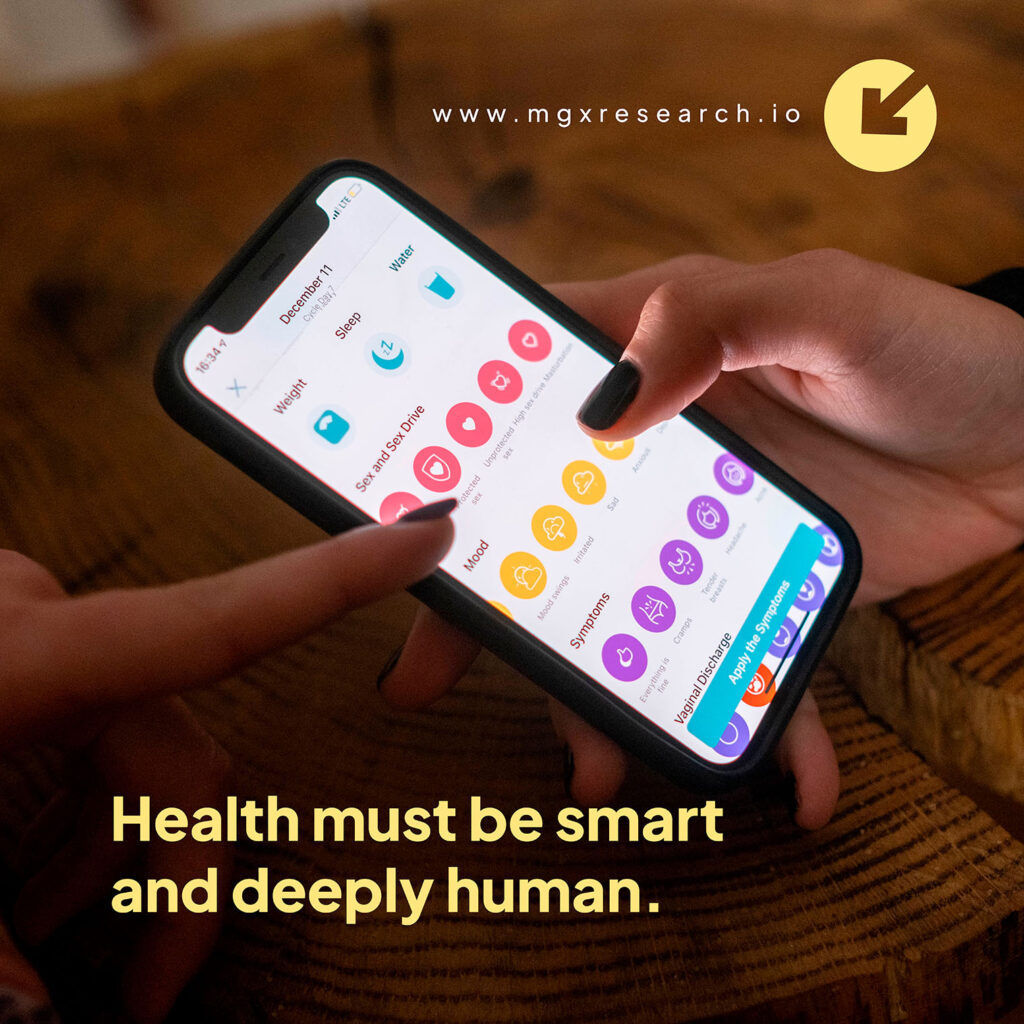
Health must be smart and deeply human.
Technology should empower healthcare, not replace its soul. True progress combines cutting-edge innovation with compassion, ensuring that care is both intelligent and intimately human.
Current Investigations & Field Studies
• AI-based health screening tools for rural primary care centers
• Design of mobile apps for mental health support in underserved youth populations
• Community-driven health dashboards using real-time local data
• Human-centered prototypes for vaccine uptake and behavioral nudging
• Interoperability frameworks for integrating HealthTech with national health systems
Our Research Approach
MGX Research brings together experts in public health, computer science, UX/UI design, epidemiology, and anthropology to tackle health challenges from multiple angles. We use participatory research methods, ethnographic studies, clinical trials, and digital prototyping to ensure our solutions are not only innovative but truly usable and sustainable.
Our Health Innovation Lab serves as a collaborative space where researchers, designers, and frontline health workers co-create and test technologies that respond to real human needs.